
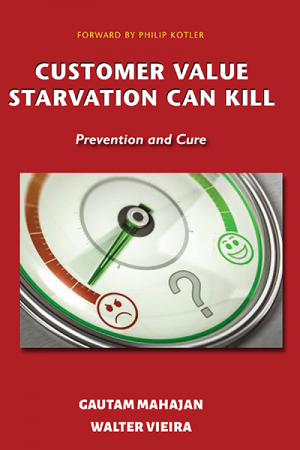
Customer Value Starvation Can Kill

Customer Value Starvation Can Kill

$34.99

Customer value starvation is a common disease in companies, both small and large – which is difficult to diagnose. It is a silent killer, like many cancers. By the time it is diagnosed, it is generally late, sometimes, too late! Mahajan and Vieira have put their expertise together to show how companies overlook value starvation. This causes irritation and frustration to customers in their interaction with the company and its personnel – in person, on telephone, net or mail. The book identifies customer DNA (Do Not Annoy) factors, and suggests how to minimize complaints; ensure customer loyalty; and long term company profitability and success. Philip Kotler, the world’s guru on marketing, said, “This book will help you think freshly about your business mission and success.” Seven well-known experts on the subject like Shep Hyken have contributed to this book. Read Customer Value Starvation Can Kill, and make life easier for your customers and yourself, and win in the marketplace!!

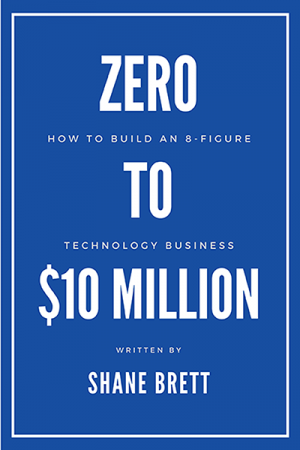
Zero to $10 Million: How To Build an 8-Figure Technology Business

Zero to $10 Million: How To Build an 8-Figure Technology Business

$31.99

Zero to $10 Million is a practical step by step guide that teaches entrepreneurs’ how to build a $10 million dollar technology business. It describes in detail how to create a great product, find a brilliant team, raise money from professional investors, and then scale the company globally.
It is what works in the “real world”.
This book is written by Shane Brett – a serial technology entrepreneur with many years’ experience of setting up, funding, and scaling technology start-ups worldwide. It follows the exact steps and processes he used to reach a $10 million dollar valuation and raise multiple rounds of funding from venture capital investors.
The text is perfect for aspiring entrepreneurs, budding founders, and anyone who wants to understand how to build a successful technology start-up from the ground up. It breaks down the mystery behind how to grow a new technology business and explains what it is actually like to be a start-up CEO and how to manage the daily challenges and constant stress.

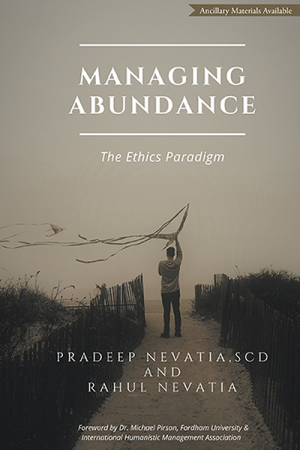
Managing Abundance: The Ethics Paradigm

Managing Abundance: The Ethics Paradigm

$31.99

“This is applied business ethics at its comprehensive best… a required-read for advanced management students and professionals alike by hands-on managers Pradeep and Rahul.” –Vijay Govindarajan, Coxe Distinguished Professor at Tuck at Dartmouth & NYT and WSJ Best Selling Author India’s rural BPO guru Pradeep Nevatia joins with New York-based hedge fund investor Rahul Nevatia to present the until-now abstract concept of abundance through an innovative managing by ethics (MBE) framework that uncompromisingly connects individual self to collective self in self-sustained abundance beyond the hocus-pocus of scarcity. As against the card-carrying management by objectives (MBO), the pioneering MBE paradigm sets human–nature co-existence as the basis to realize abundance, the source energy of all beings.
The ethics–abundance theme of this book could not be timelier for businesses to reconstruct their growth strategies for a sustainable future following the coronavirus pandemic. The industrial and financial engineering duo has leveraged their respective business turnaround and foot-on-the-gas-pedal backgrounds to thoroughly revamp the contemporary policy–goal deployment methodologies and make determined amendments to reconfigure several management processes in vogue to deliver sustainable business results in a meaningfully restructured leadership–fellowship relationship dynamic replacing the scarcity-driven everyday mill with natural rhythms of abundance.

Tax Aspects of Corporate Division

Tax Aspects of Corporate Division

$31.99

For good business reasons corporate management may conclude that the existing corporate structure should be changed. The changes may require moving assets, liabilities and ownership among of commonly controlled corporations. From the investors point of view, the corporate division may reduce risk by shielding assets from certain liabilities. Moreover, the shareholders will be able to diversify their investment as the stock of the new corporation is distributed to the shareholders of the transferring corporation. Under the general rules of income taxation, moving assets from one corporation to another may trigger taxable gain to the corporation and the shareholders. However, the Internal Revenue Code contains exceptions that allow the separation to be accomplished without taxable income to the corporation and its shareholders. But specified conditions must be satisfied for to achieve this tax abatement. When the conditions are satisfied, the shareholder is permitted to extract value from the corporation and neither the shareholder or the corporations are required to recognizing income. This book will describe the various legal forms used to divide the corporation and the conditions that must be satisfied to avoid taxable income for the corporations and their shareholders. The book is intended to be useful as a supplement to be used in an advanced corporate tax class, as well as a professional guide.

Be Agile Do Agile

Be Agile Do Agile

$34.99

The global economy and free market philosophy have resulted in higher global competition and increased expectations from customers. It is obvious that new approaches are needed to satisfy demands and many of them fall under a broad umbrella called agile. To capitalize fully on the benefits of agile, one must first understand the concepts that underpin it.

In this book, we first identify many concepts that various approaches advocate for agile and group them into three areas forming a simple, robust system. Then, we describe the most useful agile methods in savage summaries regardless of the approach that promotes them, grouping them logically and showing how to use them.

We have an agnostic agile model that can be useful to anyone using any form of agile. Both concepts for being agile and techniques for doing agile are summarized in this book and there are several ways to use this book. To understand the concepts of agile, consult Chapters 3, 4, and 5. Chapters 7, 8, and 9 will help you learn and perform agile tools and techniques.

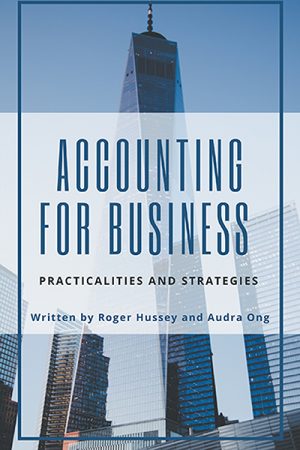
Accounting for Business: Practicalities and Strategies

Accounting for Business: Practicalities and Strategies

$31.99

As an owner of a business or a manager, you will deal with numbers of various types. This book is written for those who may be responsible for, or are generally interested in, the activities of organizations but do not have the knowledge to interpret the financial information that is available.
The book identifies the types of organizations that generate financial information and explains how you can use it for your benefit. The early chapters focus on the information that is publicly available for large companies and demonstrate how to select and analyze the figures for decision making. The later chapters concentrate on the detailed management accounting information that is available internally for managers so that they can make decisions, investigate problems, and set performance targets. The final chapter, explores emerging and very pertinent issues such as “Can the organization obtain the basic resources to stay in business?” and “Are its activities harmful to the environment?”

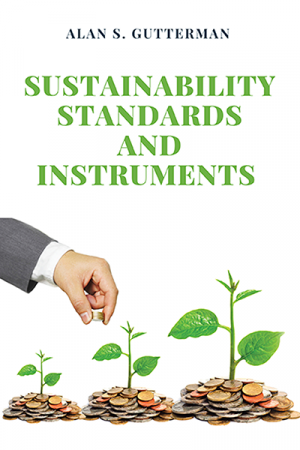
Sustainability Standards and Instruments

Sustainability Standards and Instruments

$34.99

It is becoming increasingly clear that firms can contribute to their own wealth and to overall societal wealth by considering the effect they have on the world at large when making decisions and take operational actions to execute their strategies. All of this has led to growing interest in “corporate social responsibility,” or “CSR,” which has been described as the way that firms integrate social, environmental, and economic concerns into their values, culture, decision making, strategy, and operations in a transparent and accountable manner and thereby establish better practices within the firm, create wealth, and improve society.
The commitments and activities associated with any CSR initiative should begin with compliance with laws and regulations promulgated by the governmental entities have jurisdiction over the firm’s activities; however, CSR extends well “beyond the law” to include important subjects as to which the law has not been able to keep. As a result, voluntary corporate responsibility standards developed from a variety of sources have emerged to fill the gap. This book serves as an introduction to sustainability standards and instruments and includes chapters on initiatives of governmental and intergovernmental bodies, sectoral CSR commitments, CSR-related reporting and management standards, and securities exchanges and regulators.

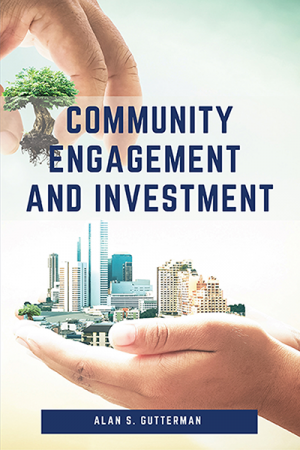
Community Engagement and Investment

Community Engagement and Investment

$34.99

Sustainability is about the long-term well-being of society, an issue that encompasses a wide range of aspirational targets including ending poverty and hunger; ensuring healthy lives and promoting well-being for all; ensuring inclusive and equitable quality education and promoting lifelong learning opportunities for all; and promoting sustained, inclusive, and sustainable economic growth, full and productive employment, and decent work for all. Clearly the challenges associated with pursuing the goals are daunting and for most businesses, it may be difficult for them to see how they can play a meaningful role in address them. Focusing on the community level allows an organization to set meaningful targets and implement programs that fit the scale of its operations and which can provide the most immediate value to the organization and its stakeholders. Societal well-being projects and initiatives must ensure that the organization does not compromise, and instead improves, the well-being of local communities through its value chain and in society-at-large.
This book is a comprehensive guide to community engagement and investment, beginning with a survey of community-related voluntary standards and then turning to strategy and management, community engagement, community investment and reporting, and communications on community-related activities.

Guerrilla Warfare in the Corporate Jungle: Adaptations for Survival

Guerrilla Warfare in the Corporate Jungle: Adaptations for Survival

$34.99

Using his experiences of life in the corporate jungle, K.F. Dochartaigh has produced a survival manual that assists and guides the reader on how best to navigate corporate pitfalls and avoid being ‘trapped’.
The book fuses three separate but intertwined disciplines of the animal kingdom, the guerrilla battlefield, and the corporate world to help establish patterns of behavior and to understand the motivations that drive each action. All three areas share a common environment: the jungle, where visibility is limited, and ambush is the only method of attack by predators. The book blends animal and human psychology and provides safe passage in all its encounters. This book does not condone war—in fact, quite the opposite—and, as you will see, it takes more of a defensive position in repelling attacks and seeks to promote the occurrence of collaboration over individual competition, which will also become apparent. It is not a “call to arms” or a promotion of anarchy—not by any stretch of the imagination—as it merely assists the individual in adapting within their environment in order to ensure their survival. Whether you work as an accountant, IT consultant, lawyer, salesperson, or project manager, the same logic still applies because there is a natural order in all corporate vocations.