
Achieving Success Through Innovation: Cases and Insights from the Hospitality, Travel, and Tourism Industry

Achieving Success Through Innovation: Cases and Insights from the Hospitality, Travel, and Tourism Industry

$21.99

This book investigates the genesis and success of innovation in the hospitality industry as detailed in over four dozen case studies. In many of the cases studies, the innovators themselves provide the insights into their innovative inspiration and the lessons learned from the way they brought their innovative ideas to life. The cases include innovations for improved customer service, stronger human resources, and new food service and lodging concepts. While updated technology forms the basis for many of the innovations, some of the cases focus specifically on technology improvements, with a particular focus on the use of technology as a mediator in the service value chain.
With the passage of several years, the book shares the outcome of the innovative concepts—most of which continue to operate. The lessons presented will provide you a valuable perspective on success through innovation, whether you are operating in the hospitality industry or another business.
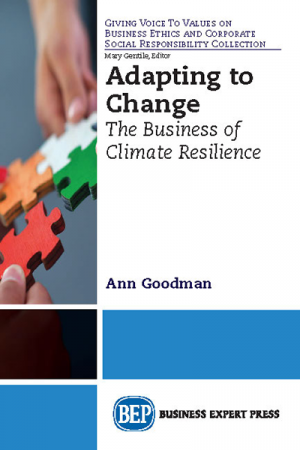
Adapting to Change: The Business of Climate Resilience

Adapting to Change: The Business of Climate Resilience

$21.99

Check out a recent book review from Project Management World Journal!!

Get an inside look at how companies with cutting-edge sustainability programs are innovating in the face of extreme conditions related to climate change. Adapting to Change profiles the current efforts of Citi, Sprint, ConAgra, Stonyfield Farm, The Hartford, and IBM to improve climate resilience, with a focus on five themes:
i. Responding to weather
ii. Learning from disaster
iii. Doing more with less
iv. Taking a risk—and managing it
v. Communicating change, collaborating on climate.
In these pages, readers will discover strategies that encourage resilience and mitigate risk across vastly different sectors, both internally—with managers and employees—and externally—through supply chains, in communities, among investors—with valuable insight for business professionals in all categories.
Adapting to Change stresses pragmatic answers to real problems that companies encounter every day. It focuses on the challenges climate presents to the firms profiled and how each company—with the help of employees and other stakeholders—faces them head on.
One in a collection of books curated by world-renowned business ethics expert Mary Gentile, this book illustrates how today’s sustainability leaders are using business acumen to find solutions—while cutting costs and creating new business opportunities—in a rapidly changing environment.

Employee LEAPS: Leveraging Engagement by Applying Positive Strategies

Employee LEAPS: Leveraging Engagement by Applying Positive Strategies

$21.99

A recent Gallup Study estimated that 7 in 10 American workers are “actively disengaged” or “not engaged” while at work, costing the economy between $450 and $550 billion per year. Employee LEAPS: Leveraging Engagement by Applying Positive Strategies?was written to increase employee engagement and optimize workplace performance. By harnessing the power of engagement and nurturing people’s innate desire to be captivated by the activities in which they are involved, Employee LEAPS has the potential to transform organizations and facilitate remarkable outcomes that extend far beyond what could be achieved otherwise.
If you are interested in increasing employee engagement and optimizing workplace performance, Employee LEAPS is the book for you. The author provides astute direction on how to increase organizational capacity and unleash talent, enabling businesses to produce exceptional results. Employees who are engaged in the activities they are involved deliver results far superior to those who are not.

Public Relations for the Public Good: How PR has Shaped America's Social Movements

Public Relations for the Public Good: How PR has Shaped America’s Social Movements

$21.99

While the profession of public relations is only a century old, man has been practicing the art of influencing public attitudes since the dawn of civilization. This book looks at modern America through the lens of public relations, showing how many of the events that have changed the course of our nation’s modern history were triggered by campaigns to influence attitudes, opinions, and behaviors.
And while the channels may have evolved in the modern era—from radio and newspapers, billboards and magazine ads, to television and the Internet, to Tumblr and Instagram—the underlying power of public relations to shape organizations and issues, and to change human behavior has not. Inside this book you’ll find case studies on campaigns from the Women’s Movement through Civil Rights to public education on health and safety issues that document the role public relations has played in shaping contemporary American culture and society.

The Illusion of Inclusion: Global Inclusion, Unconscious Bias and the Bottom Line

The Illusion of Inclusion: Global Inclusion, Unconscious Bias and the Bottom Line

$21.99

We may say we want to be inclusive, but what if we really don’t? What if our brains are hard-wired for selfishness and similarity and not for diversity and altruism? Having a diverse workforce is no guarantee that the work environment is inclusive. Companies hire for diversity and manage for similarity. We hire people for their difference and then teach them directly and indirectly what they have to do to fit in to the corporate culture.
The Illusion of Inclusion exposes a myriad of diverse reasons why people are not more fully engaged and offers you the key to unlock the “Geometry of Inclusion”. This book takes the lid off Pandora’s box and explores the complexity of inclusion; where affinity bias or “mini-me” syndrome and the need to fit in are unconsciously blocking our ability to be inclusive. It offers a road map and an easy to comprehend model on how to minimize the impact of unconscious and conscious biases in order to embed an inclusive organizational culture.

Central and Eastern European Economies: Perspectives and Challenges

Central and Eastern European Economies: Perspectives and Challenges

$21.99

Nearly seven decades ago, six countries in Western Europe (Belgium, France, West Germany, Italy, Luxembourg, and the Netherlands) decided to take economic cooperation to the next level. The vision of the EU founding states, epitomized by the Schuman Declaration in 1950, was to tie their economies so closely together that war would become impossible.
Robert Schuman, author of the plan, believed Europe could not be made all at once, or according to a single plan. It would have to be built through concrete achievements which first create a de facto solidarity. The countries within the “European Community” benefited enormously from free trade and common economic policies, in particular structural funds designed to foster convergence by funding infrastructure and investments in poorer regions.? This book examines how similar transitions and integration into the European Union are experienced in individual central and eastern European states through the use of country scans in the regional blocks of CEE, SEE, and CIS.

Audit Committee Formation in the Aftermath of 2007-2009 Global Financial Crisis, Volume III: Emerging Issues

Audit Committee Formation in the Aftermath of 2007-2009 Global Financial Crisis, Volume III: Emerging Issues

$21.99

The audit committee has gained considerable attention in the aftermath of 2007–2009 global financial crisis. The audit committee’s role has evolved from a voluntary liaison between management and external auditors to the standing committee of the board of directors in overseeing all aspects of corporate governance, financial reporting, internal controls, risk assessment, and audit activities.
This book addresses the determinants of audit committee oversight effectiveness, including their composition, independence, authority, resources, diligence, and activities. The book is organized into three separate volumes and each volume can be utilized separately or in an integrated form. The first volume consists of five chapters, which examine the relevance and fundamentals of the audit committees as well as the determinants of audit committee effectiveness. The second volume consists of nine chapters on financial, auditing, internal control, risk management, ethics and compliance, antifraud, and other oversight functions of the audit committee. The third volume consists of five chapters on the emerging issues of audit committees pertaining to evaluation, education, reporting, and accountability as well as audit committees of private companies, governmental entities and not-for-profit organizations.

Audit Committee Formation in the Aftermath of the 2007–2009 Global Financial Crisis, Volume I: Structure and Roles

Audit Committee Formation in the Aftermath of the 2007–2009 Global Financial Crisis, Volume I: Structure and Roles

$21.99

The audit committee has gained considerable attention in the aftermath of 2007–2009 global financial crisis. The audit committee’s role has evolved from a voluntary liaison between management and external auditors to the standing committee of the board of directors in overseeing all aspects of corporate governance, financial reporting, internal controls, risk assessment, and audit activities.
This book addresses the determinants of audit committee oversight effectiveness, including their composition, independence, authority, resources, diligence, and activities. The book is organized into three separate volumes and each volume can be utilized separately or in an integrated form. The first volume consists of five chapters, which examine the relevance and fundamentals of the audit committees as well as the determinants of audit committee effectiveness. The second volume consists of nine chapters on financial, auditing, internal control, risk management, ethics and compliance, antifraud, and other oversight functions of the audit committee. The third volume consists of five chapters on the emerging issues of audit committees pertaining to evaluation, education, reporting, and accountability as well as audit committees of private companies, governmental entities and not-for-profit organizations.

Audit Committee Formation in the Aftermath of the 2007–2009 Global Financial Crisis, Volume II: Responsibilities and Sustainability

Audit Committee Formation in the Aftermath of the 2007–2009 Global Financial Crisis, Volume II: Responsibilities and Sustainability

$21.99

The audit committee has gained considerable attention in the aftermath of 2007–2009 global financial crisis. The audit committee’s role has evolved from a voluntary liaison between management and external auditors to the standing committee of the board of directors in overseeing all aspects of corporate governance, financial reporting, internal controls, risk assessment, and audit activities.
This book addresses the determinants of audit committee oversight effectiveness, including their composition, independence, authority, resources, diligence, and activities. The book is organized into three separate volumes and each volume can be utilized separately or in an integrated form. The first volume consists of five chapters, which examine the relevance and fundamentals of the audit committees as well as the determinants of audit committee effectiveness. The second volume consists of nine chapters on financial, auditing, internal control, risk management, ethics and compliance, antifraud, and other oversight functions of the audit committee. The third volume consists of five chapters on the emerging issues of audit committees pertaining to evaluation, education, reporting, and accountability as well as audit committees of private companies, governmental entities and not-for-profit organizations.